
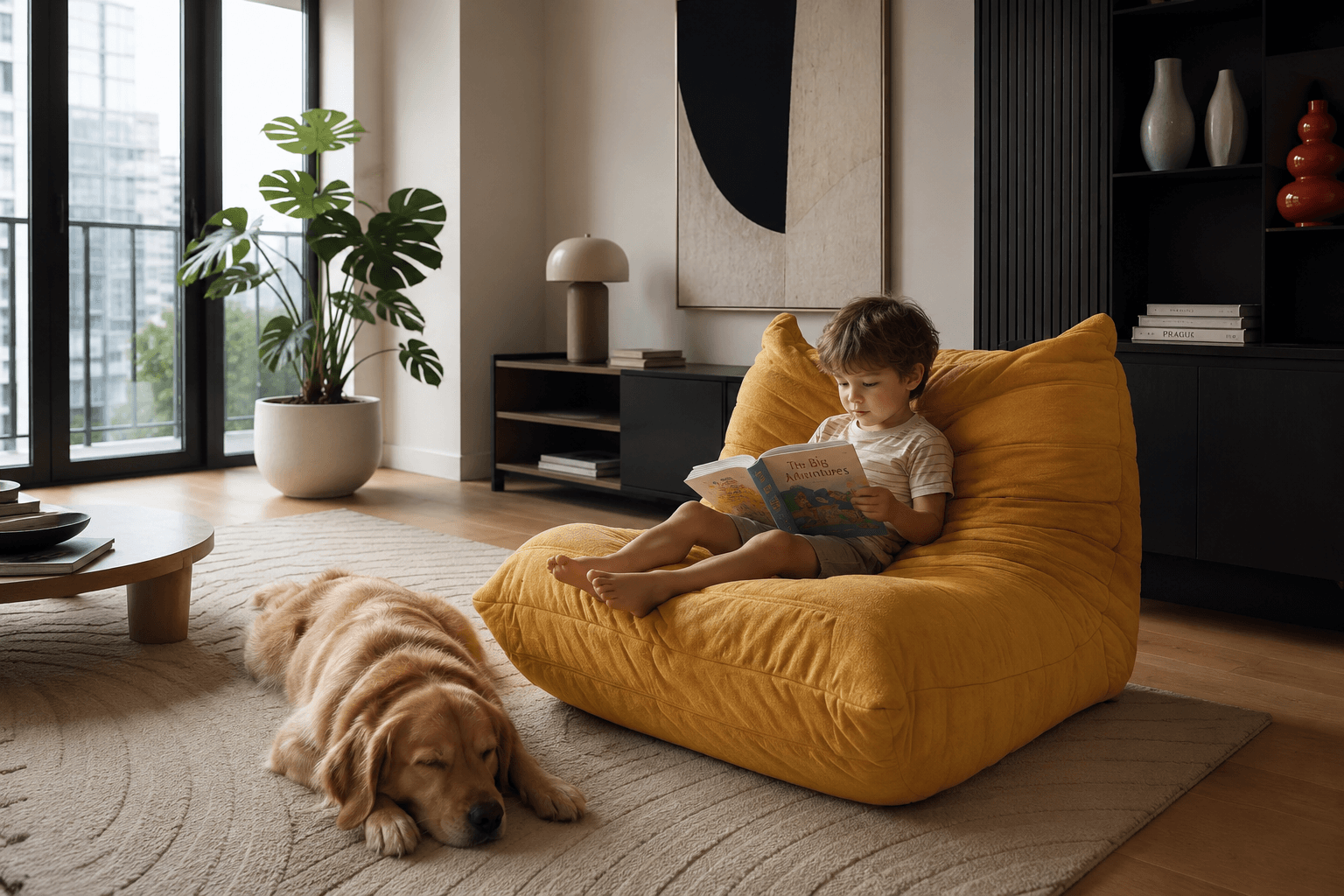
When there's a baby crawling on the rug or a dog that treats the couch as a second bed, "is this sofa actually safe?" stops being an abstract question. New furniture can carry an off-gassing smell, and it's fair to want to know what you're breathing — and what your kids and pets are pressing their faces into every day.
The honest truth is that the word "non-toxic" isn't regulated, so anyone can print it. What does mean something is third-party certification. If you're shopping for a non-toxic sofa in Canada, this guide explains the certifications that actually matter, what each one tests for, and how to tell a genuinely low-emission sofa from a marketing label.
Why "non-toxic" alone isn't enough
Here's the catch with sofa shopping: "non-toxic," "eco" and "safe" are marketing words with no fixed definition. A brand can use them without testing anything. The thing you actually want to know is whether the materials have been independently tested by a recognised standard — because that's a claim a company can't just make up.
The concern most people are really asking about is VOCs (volatile organic compounds) and formaldehyde — the chemicals responsible for that "new furniture" smell, and the ones you'd rather not have a low-to-the-ground toddler breathing. So instead of trusting an adjective, look for these four certifications.
The certifications that actually matter
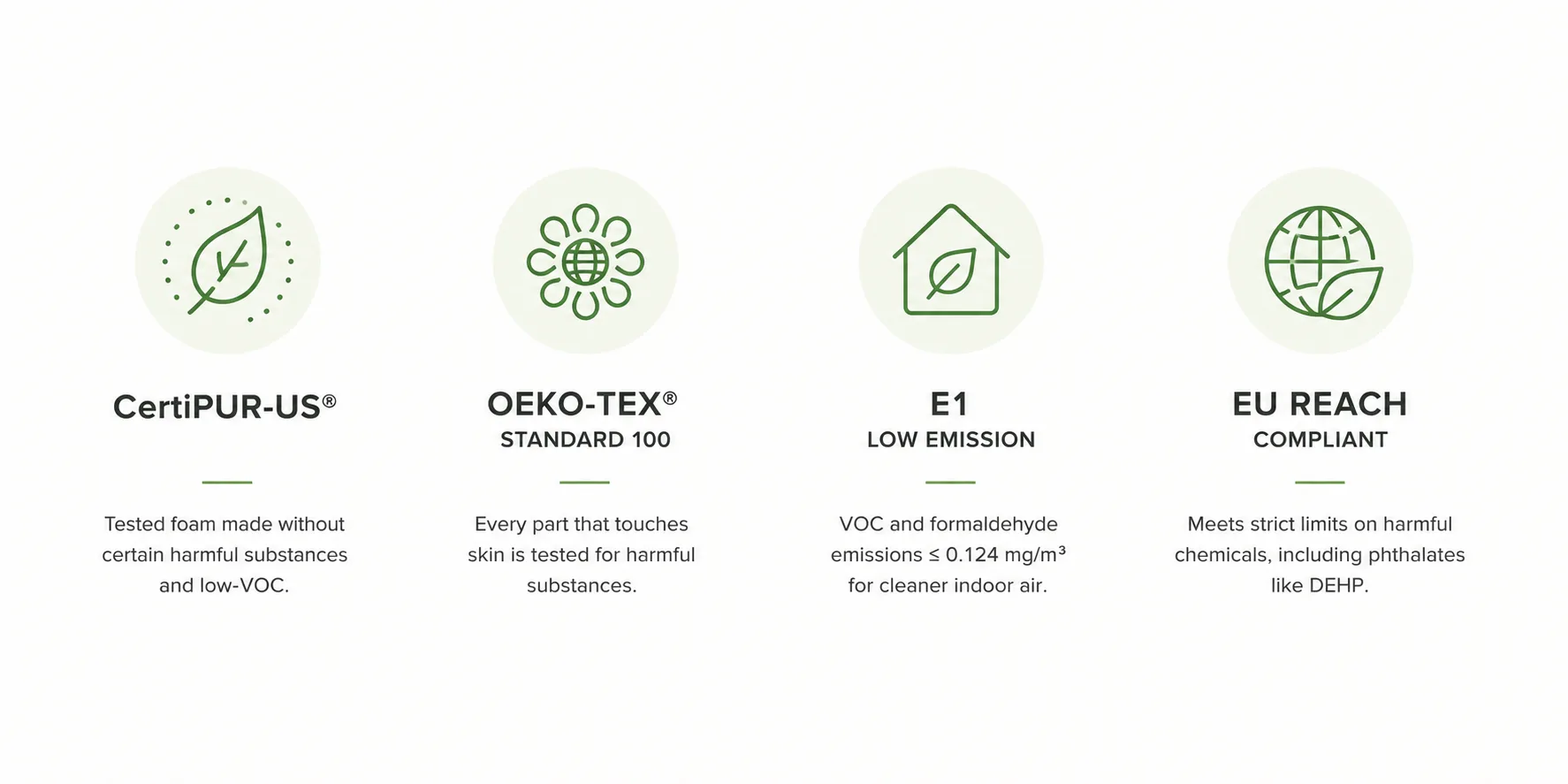
CertiPUR-US — for the foam
The foam is the biggest single material in a sofa, so it's the first place to check. CertiPUR-US is an independent program that tests flexible polyurethane foam for content, emissions and durability. A CertiPUR-US certification means the foam is made without certain harmful substances and is low-VOC — and, as a bonus, that it's built to keep its shape and support over time. For a sofa your family sits on every day, certified foam is the baseline, not a luxury.
OEKO-Tex Standard 100 — for the textiles
OEKO-Tex Standard 100 tests every component of a textile — the fabric, the threads, even trims — for a long list of harmful substances. When a sofa is tested to this standard, it means the parts that touch skin have been screened for the chemicals you'd want kept out of a home with children. It's one of the most widely recognised textile-safety certifications in the world.
E1 low-emission — for formaldehyde and VOCs
E1 is a low-emission classification. On our sofas it means VOC and formaldehyde emissions are held to ≤0.124 mg/m³ — a strict ceiling on exactly the off-gassing compounds people worry about. This is the number that speaks most directly to indoor air quality, which matters a lot in a small, well-sealed Canadian apartment where there's less airflow to disperse anything.
EU REACH — for the broader chemistry
REACH is the European Union's wide-reaching chemical-safety regulation. REACH compliance includes limits on phthalates such as DEHP — softening chemicals you specifically don't want in items for children's spaces. A sofa that meets REACH limits has cleared one of the most comprehensive chemical frameworks there is.
What this means for kids and pets, practically
Put those four together and you get the thing parents and pet owners actually want: low-VOC materials that are safe for homes with kids and pets. Less off-gassing smell, fewer harmful substances in the foam and fabric, and limits on the chemicals you'd least want a crawling baby or a napping dog exposed to.
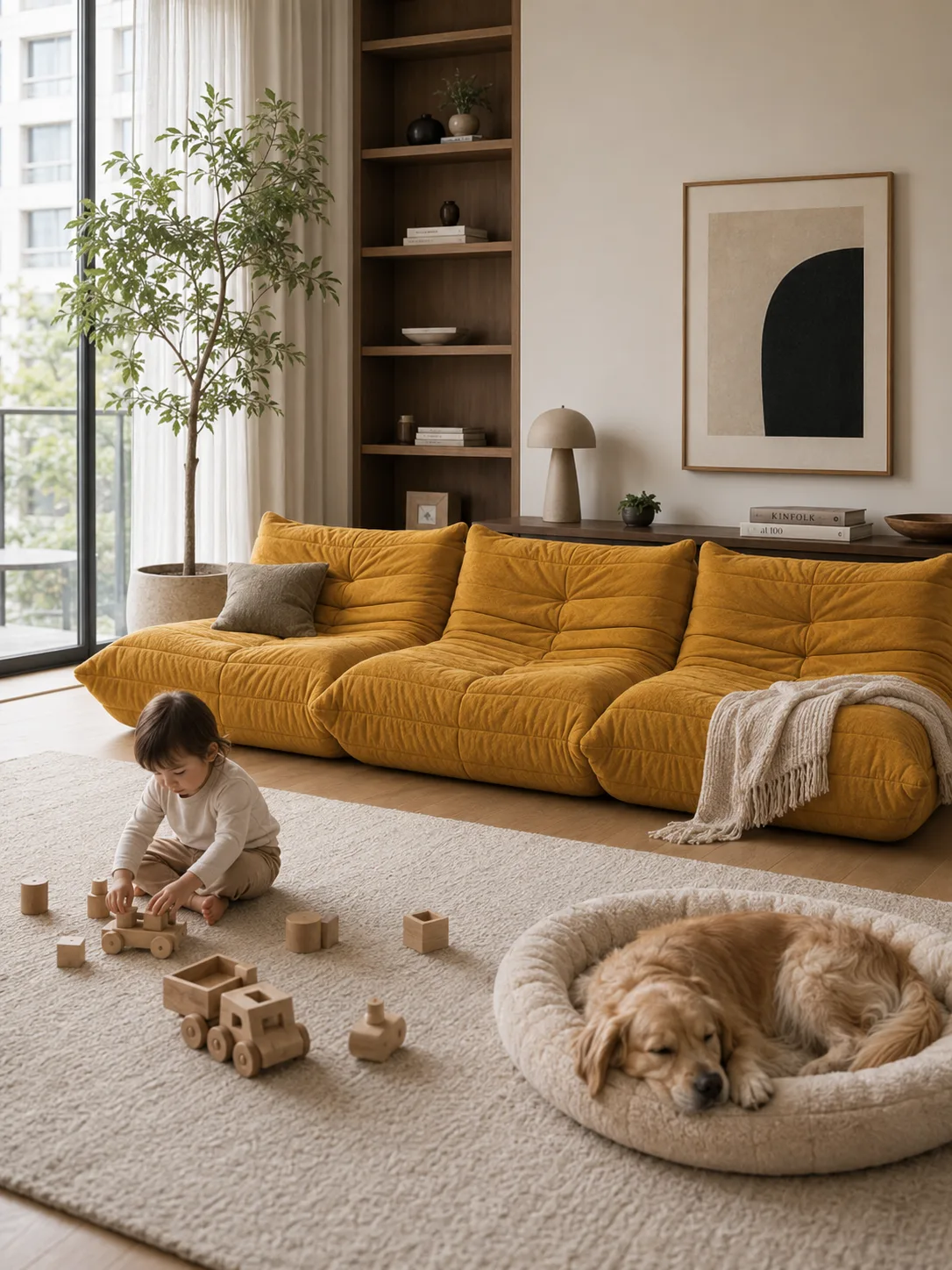
Every sofa in our Sofa-in-a-Box collection is built with CertiPUR-US certified foam and tested to OEKO-Tex Standard 100, E1 low-emission and EU REACH standards. We list those because they're verifiable claims — not because "non-toxic" sounds nice. (We'll be straight on the limits, too: certifications speak to the materials, and we don't make medical or health-outcome claims beyond what those standards actually test.)
How to verify a "non-toxic" sofa yourself
Whether you buy from us or anyone else, use this quick checklist before you trust a safety claim:
Look for named certifications, not adjectives. "Non-toxic" on its own means little; "CertiPUR-US foam, OEKO-Tex Standard 100" is a testable claim.
Check the foam and the fabric. They're certified by different standards (CertiPUR-US for foam, OEKO-Tex for textiles) — you want both covered.
Look for an emissions figure. An E1 / low-emission rating with an actual number (like ≤0.124 mg/m³) is stronger than a vague "low-VOC."
Air out any new sofa. Even certified furniture benefits from a few days of ventilation in the room after setup.
A boxed sofa has a small practical advantage here too: because it ships compressed and vacuum-packed and you unpack it in your own well-ventilated room, you control the airing-out from the very first hour.
Safe materials, easy to live with
A kid-and-pet-safe sofa shouldn't also be a hassle to own. Ours pair the certifications above with the sofa-in-a-box design: they fit through tight doorways and up stairs, and set up with no tools and no hardware — you unpack the modules, let the foam regain its shape, and connect the pieces. A couple of family-friendly places to start:
The Caterpillar modular floor sofa — deep, low-profile seating that's easy for little ones to climb on safely.
The Cozeo chenille modular sofa — soft, durable chenille with sectional flexibility for a growing family.
The Nesté chenille accent chair — a simple, certified extra seat for a nursery or reading corner.
The bottom line
A genuinely non-toxic sofa in Canada is one whose safety you can verify, not just read on a label. Look for CertiPUR-US foam, OEKO-Tex Standard 100 textiles, an E1 low-emission rating with a real number, and REACH compliance — together they mean low-VOC materials that are safe for homes with kids and pets. Start with the Sofa-in-a-Box collection, where every sofa carries those certifications by design.
Frequently asked questions
Are the materials in your sofas safe for kids and pets?
Yes. Every sofa uses CertiPUR-US certified foam and is tested to OEKO-Tex Standard 100, E1 low-emission and EU REACH standards — low-VOC and safe for homes with kids and pets.
What does CertiPUR-US mean?
CertiPUR-US is an independent certification for flexible polyurethane foam. It means the foam is made without certain harmful substances, is low-VOC, and is tested for durability so it keeps its shape and support over time.
What is an E1 low-emission rating?
E1 is a low-emission classification. On our sofas it caps VOC and formaldehyde emissions at ≤0.124 mg/m³ — a strict limit on the off-gassing compounds responsible for "new furniture" smell, which is especially relevant in small, well-sealed apartments.
How can I reduce off-gassing from a new sofa?
Choose one with named certifications (CertiPUR-US, OEKO-Tex, E1, REACH) and air it out in the room for a few days after setup. A sofa-in-a-box helps, since you unpack and expand it in your own ventilated space.