

If you've never bought furniture before, the scariest part isn't picking a style — it's that you have no idea what "normal" costs. Is $500 a lot for a sofa, or nothing? Should a bedroom cost $800 or $8,000? So how much does it cost to furnish an apartment? The honest answer is a range, but a range you can actually plan around — and once you understand why prices swing so wildly, you can spend a lot less without ending up with furniture that falls apart in a year.
Here's a realistic, room-by-room budget for a first apartment in Canada, plus the one thing most guides skip: what you're actually paying for when one sofa costs $300 and a nearly identical one costs $3,000.
The short answer
For a one-bedroom apartment (living room + bedroom), furnished from scratch at Canadian retailers, a sensible all-in budget lands around:
Smart budget: roughly $2,400–$2,800 for both rooms — decent, comfortable pieces without overpaying.
Mid-range: roughly $5,500–$6,100 for both rooms — better materials, bigger pieces, longer-lasting.
That's furniture only (sofa, bed, mattress, tables, lighting, rug, basic decor) — not appliances or a TV. And an important catch: those numbers are the sticker prices, not the "out-the-door" cost. In real life you usually pay two more things on top:
- Delivery / freight — many furniture stores charge to deliver bulky pieces, and a full-size sofa or bed is where it hurts most.
- Assembly — flat-pack furniture (think IKEA) either eats an afternoon or costs extra if you hire it out.
So the honest all-in number is often a few hundred dollars higher than the tables below — unless you deliberately buy pieces that skip those fees. We'll come back to that, because it's the single easiest way to keep a first-apartment budget from creeping. The rest of this guide breaks it down room by room so you can see where every dollar goes, and where it's safe to save.
Why the same piece can cost $100 or $3,000
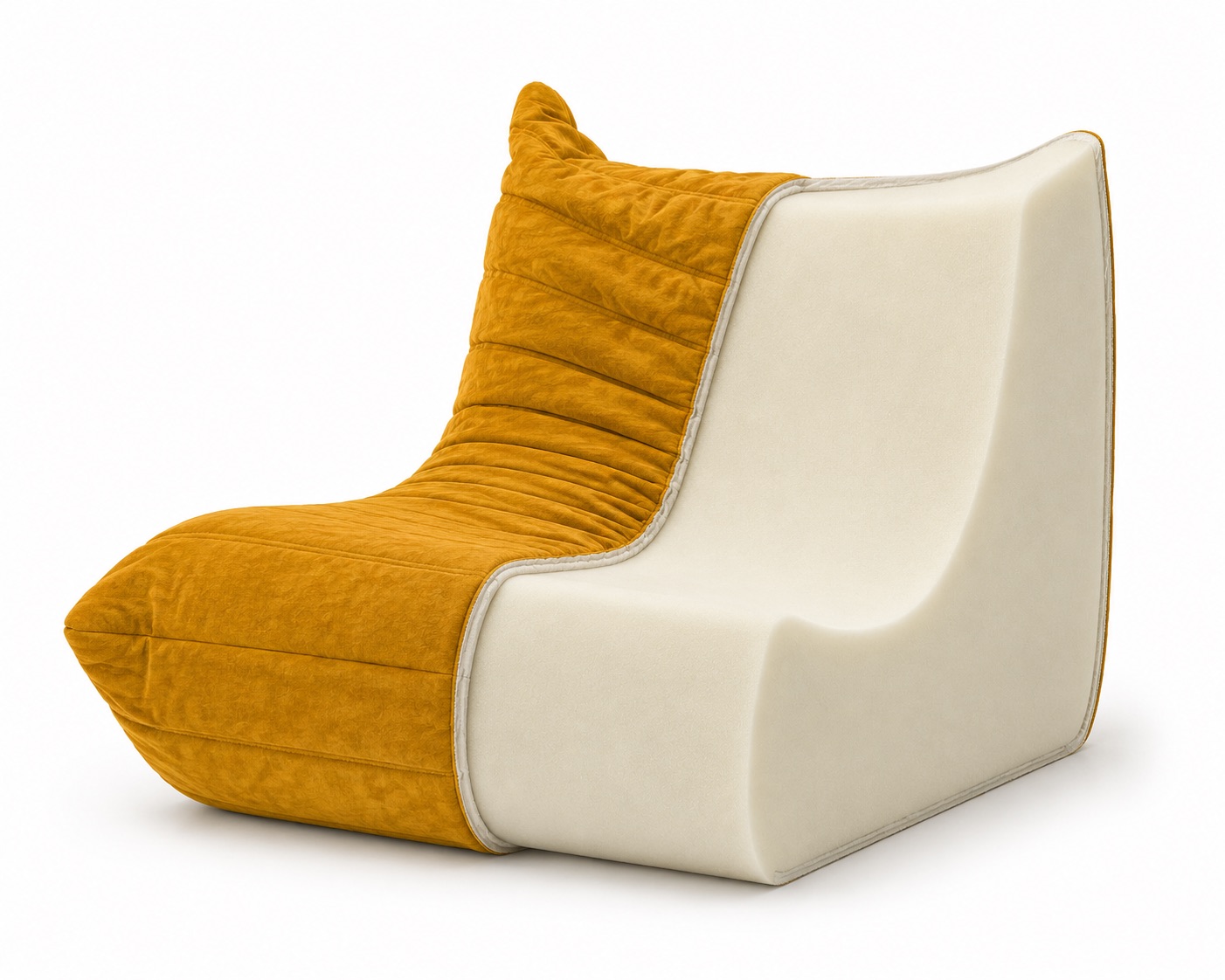
Before the budgets, this is the concept that makes everything else make sense: furniture price is mostly a materials story. Two sofas can look identical in a photo and be built completely differently. Here's what actually moves the price — using sofas as the example, since that's the piece people overspend or underspend on most.
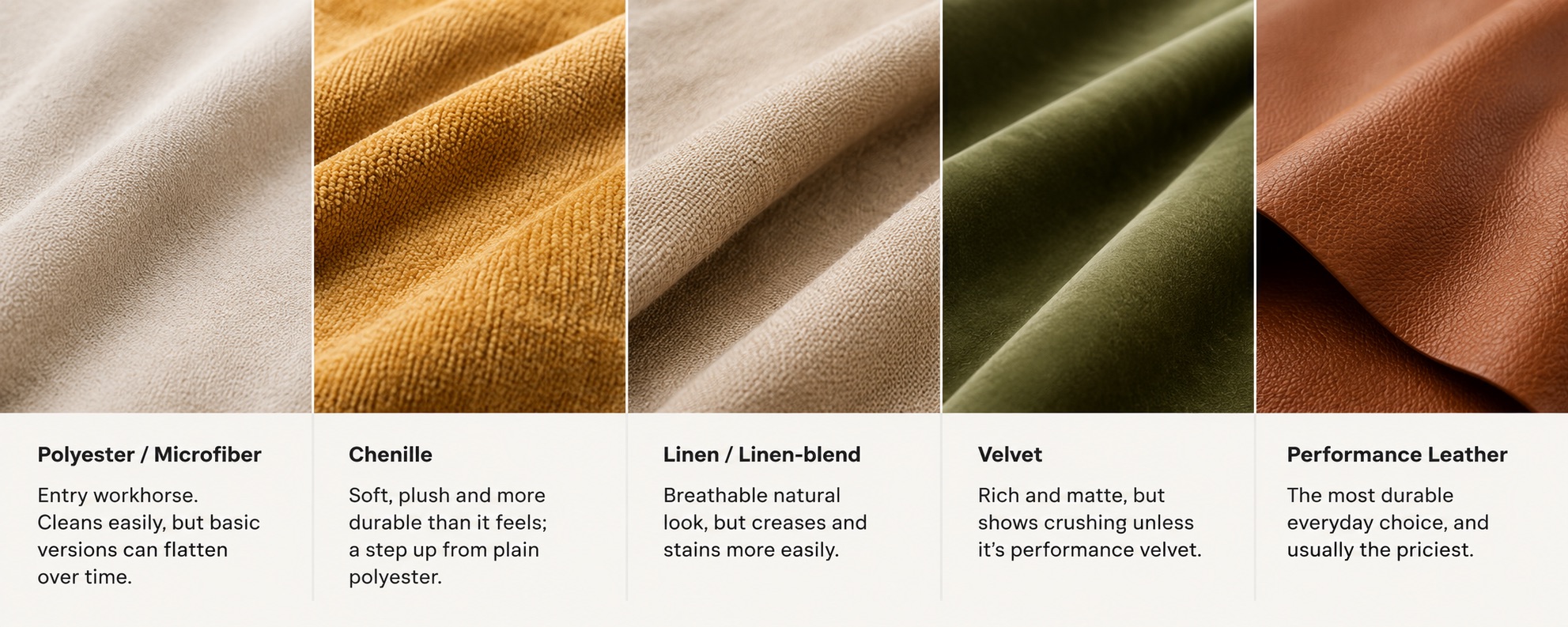
1. The fabric (the part you see and touch)
From cheapest to priciest, roughly:
Polyester / microfiber — the entry workhorse. Cleans easily, but basic versions can flatten over time.
Chenille — soft, plush and more durable than it feels; a step up from plain polyester. (It's what all of our sofas are woven in.)
Linen / linen-blend — breathable natural look, but creases and stains more easily.
Velvet — rich and matte, but shows crushing unless it's performance velvet.
Performance fabric — the most durable everyday choice (tight weave, stain-resistant, pet-and-kid friendly), and usually the priciest.
For leather, the gap is even bigger: cheap bonded leather is shredded scrap glued to backing and peels within a few years, while full-grain leather lasts decades. On one popular sofa sold in two versions, the velvet is about $1,800 and the top-grain leather version is about $2,500 — that ~$700 jump is purely the "real leather" upgrade.
2. The cushion fill (the part you feel)
Standard foam — fine at first, but low-density versions sag and leave a dent where you sit.
High-density (HD) foam — holds its shape and support for years; the quality default on better sofas. (Ours use CertiPUR-US-certified HD foam.)
Feather / down blend — plushest "sink-in" feel, costs the most, and needs regular fluffing.
3. The frame (the part you never see — and the one that fails first on cheap furniture)
Particleboard / MDF — cheapest, holds screws poorly, tends to squeak and loosen in a few years.
Plywood — furniture-grade plywood resists warping and is genuinely solid.
Kiln-dried hardwood — won't warp or crack, lasts 15–30+ years, and carries the longest warranties.
A shortcut to judge quality without seeing the frame: look at the warranty. A lifetime or 25-year frame warranty almost always means kiln-dried hardwood; a 3-year warranty usually means engineered board.
4. Certifications (what you pay for that you can't see or feel)
Part of a higher price is materials that have been independently tested — a claim a brand can't just print on a tag. It's worth knowing what the badges mean, because they cover different parts of the sofa:
CertiPUR-US — the foam: made without certain harmful substances, low-VOC, and tested to keep its shape and support over time.
OEKO-Tex Standard 100 — the fabric and threads: screened for a long list of harmful substances.
E1 low-emission — air quality: caps VOC and formaldehyde off-gassing (on ours, ≤0.124 mg/m³) — the "new furniture smell" you'd rather not have in a small apartment.
EU REACH — the broader chemistry: limits phthalates like DEHP.
Cheap furniture often skips all of this, which is part of why it's cheap. All of our sofas carry these four — if you want the full breakdown of what each one tests for (and why it matters with kids or pets around), see is this sofa safe for kids & pets? certifications, explained.
So how do you decide? Match the price to how long you'll keep it
Here's the whole section in one rule: a higher price is buying better material quality, so match your tier to two things — how long you'll keep the piece and how hard you'll use it.
Those two levers matter together, not separately:
How long you'll keep it. A rental or first-place piece you'll replace in a year or two doesn't need a lifetime frame. Something you want to keep for a decade does — kiln-dried hardwood and performance fabric cost more up front but are cheaper per year of use.
How often (and how hard) you'll use it. This is the one people forget. A sofa you sit on every single day in the living room or bedroom takes far more wear than one in a guest room or a basement you visit a few times a month. The high-traffic piece is where HD foam and a solid frame pay off; the occasional-use piece can safely be entry-tier even if you keep it for years.
Put simply:
Where it lives / how you use it | Sensible tier |
Everyday living room or bedroom sofa/bed | Mid to high — HD foam, durable fabric, plywood or hardwood frame |
Occasional basement, guest room, home-office chair | Entry to mid — basic-to-HD foam is plenty; don't overpay |
Short-term rental you'll replace soon | Entry — and don't feel bad about it |
Then weigh material preference honestly: if you have pets or kids, lean to durable, cleanable fabric (chenille or a performance weave) over delicate linen or velvet; if air quality is the priority, prioritise the certifications above. The "right" price isn't the highest or the lowest — it's the tier that matches how long and how often you'll actually live with the piece.
Now the budgets.
Living room budget
The sofa is the big line item — and the one where knowing the above saves you the most. Here's a realistic Canadian breakdown at two levels:
Piece | Smart budget | Mid-range | What changes |
Sofa (2-seat loveseat) | $300–$500 | $1,000–$1,400 | Entry fabric + basic frame → better fabric, HD foam, kiln-dried frame |
Coffee table | $350 | $650 | Laminate/metal → solid wood or storage |
Area rug | $120 (5×8) | $300 (8×10) | Synthetic flatweave → denser pile or wool blend |
Lighting | $90 | $240 | Bare metal → dimmable, nicer shade |
TV stand | $200 | $750 | Compact laminate → larger, closed storage |
Accent chair | $150 | $350 | Basic fabric → swivel/bouclé, hardwood legs |
Curtains (one window) | $150 | $350 | Basic fabric → swivel/bouclé, hardwood legs |
Decor (cushions, art, a plant) | $70 | $130 | Basics → filled cushions, larger art |
Living room total | ~$1,050–$1,250 | ~$2,700–$3,000 |
Ranges reflect prices at Canadian retailers like IKEA, Structube, Leon's, Article and EQ3 in 2026; "smart" figures assume some sale pricing.
Notice the sofa alone can be half the room. That's exactly why it pays to buy a well-built one cleverly rather than either overspending or buying the cheapest particleboard-frame couch that dies in two years.
Bedroom budget
The bedroom's big line item is the mattress — the one place we'd tell a first-timer not to buy the absolute cheapest.
Piece | Smart budget | Mid-range | What changes |
Bed frame (queen) | $380 (platform) | $1500 (storage/upholstered) | Bare pine → solid or padded with storage |
Mattress (queen) | $500 (all-foam) | $1050 (hybrid) | Basic foam → pocket-coil hybrid (cooler, better support) |
Nightstands (×2) | $200 | $500 | Particleboard → part solid wood |
Dresser (6-drawer) | $250 | $700 | Laminate → larger veneer/solid |
Lamps (×2) | $120 | $280 | Basic → ceramic, dimmable |
Bedding (sheets, duvet, pillows) | $230 | $400 | Basic cotton → sateen + down-alt |
Bedroom rug | $100 | $300 | Synthetic → wool blend |
Bedroom total | ~$1,300–$1,450 | ~$2,800–$3,100 |
Sources: IKEA, The Brick, Structube, Article, EQ3, plus bed-in-a-box mattress brands, 2026. Boxed mattress brands discount often, so real prices frequently land lower.
Where a sofa-in-a-box changes the math

Look back at the living-room table and you'll notice something: the smart sofa number is low because of how you buy, not because you settled for junk. A sofa-in-a-box is a real, full-size sofa that ships compressed and vacuum-packed in a compact carton, then expands to full size at home.
For a first apartment, that quietly removes costs the tables above don't even show:
No delivery/freight fee — it's car-friendly, so you can often pick it up yourself. (More on that in [how to pick up a sofa and skip the freight wait](/ca/blog/sofa-you-can-pick-up-canada).)
No movers or van rental — it's light enough to carry up walk-up stairs, and fits through narrow doorways and standard elevators.
No assembly cost — no tools, no hardware; unpack the modules, let the HD foam regain shape (full size at about 48 hours), and connect the pieces.
Those hidden delivery and moving costs — freight on a full-size sofa, a van rental when it won't fit your car, or movers when a bulky frame won't clear the stairs — are the ones that quietly blow a first-time budget. Because our sofas are also modular, they adapt as your space changes and separate into individual pieces that are far easier to carry and move than a one-piece couch — so changing your layout, or your address, doesn't have to mean hiring a crew.
Our own starting prices sit right at the "smart" end of that living-room table:
Cozeo chenille modular sofa — from $199; sectional flexibility in soft chenille, split it for guests or join it for movie night.
Caterpillar modular floor sofa — from $299; deep, low-profile seating that keeps a small space feeling open.
Nesté chenille accent chair— from $299; the easiest, most affordable first piece to carry in.
How to stretch a first-apartment budget
A few rules that save real money without buying regret:
Spend on what you use daily, save on what you don't. A good sofa and a decent mattress earn every dollar. A designer coffee table doesn't.
Never buy the cheapest mattress or the cheapest frame. A sagging foam mattress and a squeaking particleboard bed are the two "savings" people replace first.
Buy pieces that avoid delivery and moving fees — boxed, car-friendly furniture keeps hundreds of dollars in your pocket.
Choose modular and multi-use. One piece that reconfigures beats three you outgrow.
Redirect what you save into cheap, high-impact touches — a rug to anchor the room, warm lamp light instead of one harsh ceiling bulb, and a plant or two. That's what visitors actually notice.
The bottom line
So, how much does it cost to furnish an apartment? Plan for roughly $2,400–$2,800 to do a living room and bedroom smartly, or $5,500–$6,100 for a mid-range setup — furniture only. The single biggest lever is understanding that price is a materials story: pay for HD foam and a solid frame where it counts, skip the bonded leather and particleboard, and buy your sofa in a way that dodges delivery and moving fees entirely. Start with the Sofa-in-a-Box collection and build the room around the one piece you'll use the most.
Frequently asked questions
How much does it cost to furnish a one-bedroom apartment in Canada?
Realistically, about $2,400–$2,800 for a smart-budget living room and bedroom, or $5,500–$6,100 for a mid-range setup, furniture only (sofa, bed, mattress, tables, lighting, rug and basic decor). Appliances and electronics are extra.
How much should I spend on a sofa?
Entry fabric sofas start around $300, mid-range runs $700–$1,400, and premium leather or Canadian-made pieces go well past $2,000. What matters more than the number is what's inside: high-density foam and a kiln-dried or plywood frame last far longer than cheap foam on a particleboard frame. A modular sofa-in-a-box starts as low as $199 and avoids delivery and moving fees on top.
Why are some sofas so much cheaper than others?
Mostly materials. The fabric (polyester vs chenille vs performance fabric vs leather), the cushion fill (standard vs high-density foam vs down), and the frame (particleboard vs plywood vs kiln-dried hardwood) each move the price. A long frame warranty and certifications like CertiPUR-US and OEKO-Tex are good signals of what you're actually paying for.
What furniture should I buy first for a first apartment?
Prioritise the pieces you use every day: a sofa, a bed frame and a good-enough mattress. Add a table, lighting and a rug next. Decor comes last — it's cheap and easy to add over time.
Will a sofa-in-a-box fit through narrow doorways and up stairs?
Yes — that's the point. Because it ships compressed in a compact box, it fits through tight doorways, hallways and standard elevators, and is light enough to carry up walk-up stairs without movers.